

A space for all: Just Playin’ Around at the Jordan Schnitzer Museum of Art at Portland State University
A museum show offers a rare opportunity to experience joy during politically chaotic times. Review by Sarah Diver.

The 20-year-old gallery attendant plucks an iPad from the nearby wall and asks, “Are you familiar with AR?” The look on my face must have revealed a certain hesitation. I fumble through a response as she scans a QR code that looks like a Rorschach blot on the device’s purple housing. I watch as the basement-level gallery space transforms on the screen into an abstracted forest of brushstroke-like beings. It was part of Jeremy Rotsztain’s Long Lines (2025), an augmented reality app created for the current exhibition, Just Playin’ Around, at the Jordan Schnitzer Museum of Art at Portland State University. “If you touch the different shapes, they pick up on colors in the room,” she smiled. I thanked her, and she cruised back to her post at the front desk.
I can’t help but find interactions like this to encapsulate the spirit of what a quality university museum does: it bridges the gap between student campus life, the community, and great works of art. Just Playin’ Around, curated by husband-and-wife team Theo and Nancy Downes-Le Guin, offers just that—a means for audiences to engage freely with a diverse range of artistic practices in a friendly and digestible way. Even more important, the exhibition gives meaningful real estate to Portland-based artists to showcase their ideas, building a site for creative dialogue between students, community members, and local creatives.
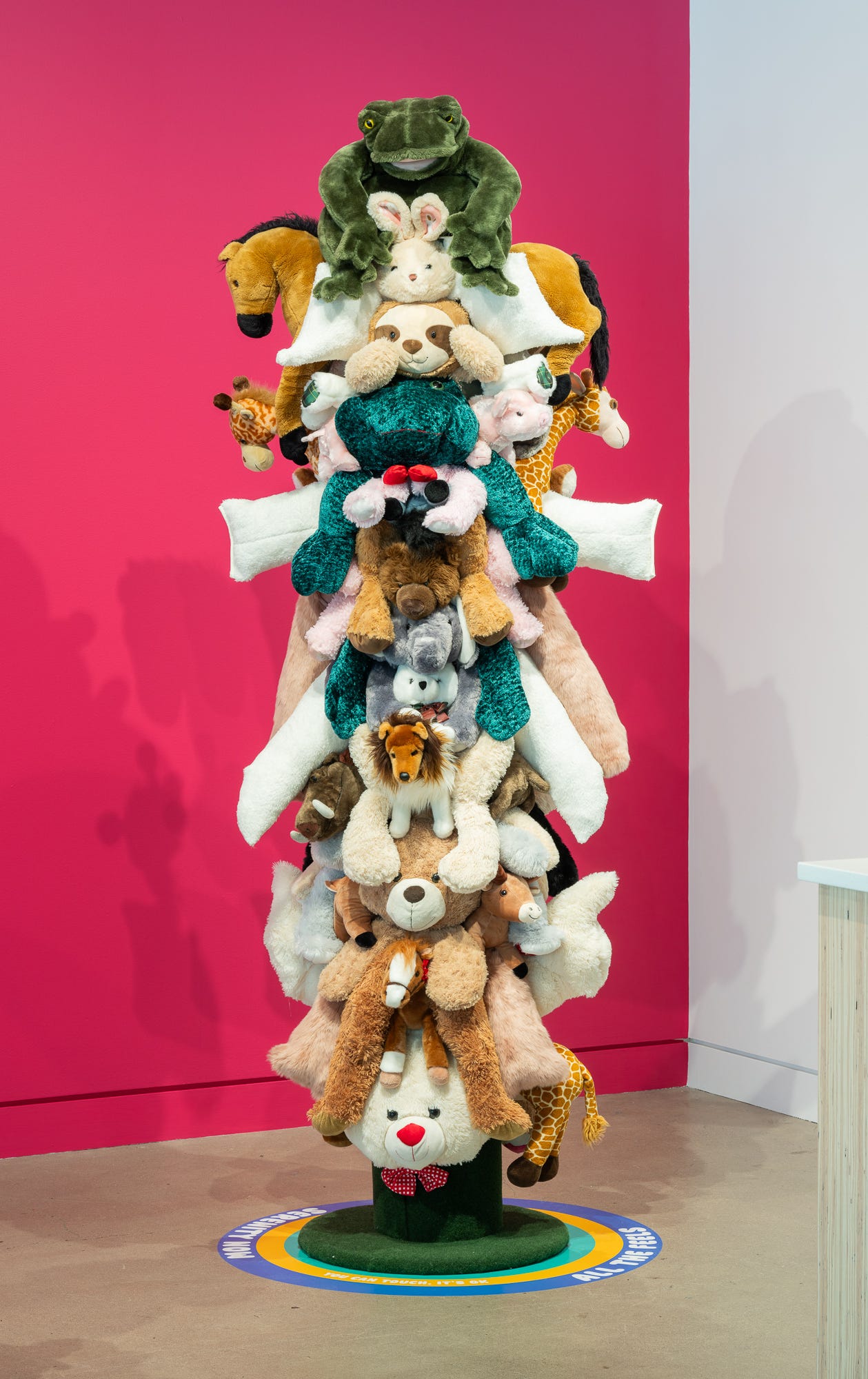
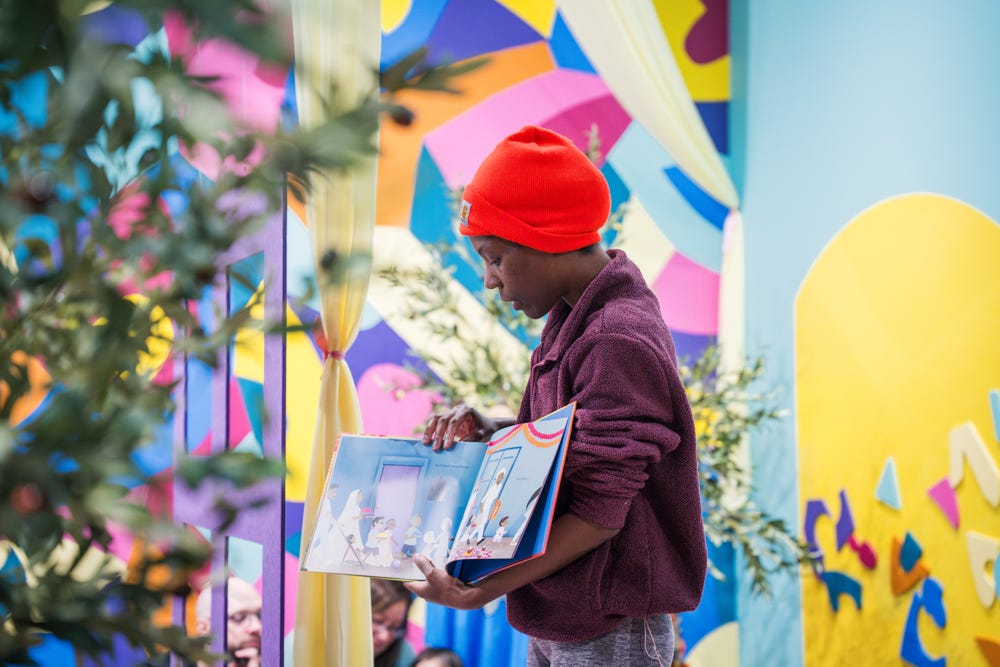
The concept of play as both a method and subject matter for art acts as a delightful gateway into exploring the idea from multiple vantage points, where each work in the exhibition enriches the conceptual framework in a new way, like a chorus of voices. Fun, bright, and interactive, the towering columns of stuffed animals by Joshua Sin, Serenity Now (2025) and Power Up (2025), greet visitors as they enter the gallery, bringing monumentality and new life to the previously loved stuffies, as viewers are invited to wrap their arms around the sculpture. In the downstairs gallery, another Portland-based artist, Latoya Lovely, designed a site-specific, all-ages installation titled On a Lovely Sunday Morning (2025) in collaboration with her 8-year-old son. Clothes for playing dress-up, interactive games, and books all fill a colorful corner that feels welcoming and warm to both children and adults. These brightly colored, eye-catching works both speak to the importance of play for psychological well-being, both materially and literally, as viewers enact play through their experience of each.
Quieter photographic works in the exhibition offer a beautiful contrast to the louder pieces. Vancouver-based artist Calvin Chen’s black-and-white series Cómo Juegan los Niños (2015–2018), which translates to “how children play,” captures children exploring what appear to be ecologically devastated environments. In one shot, a child climbs a pile of felled old-growth timber in a pair of flip-flops. I found myself recalling my own memories of that child-like sense of wonder and excitement at the prospect of climbing a big pile, while also swallowing the bitter fact that this child’s playground was likely created through unsustainable and irreversible timber practices—complicating the universality of play by underscoring the privilege of how play manifests in different places around the world.
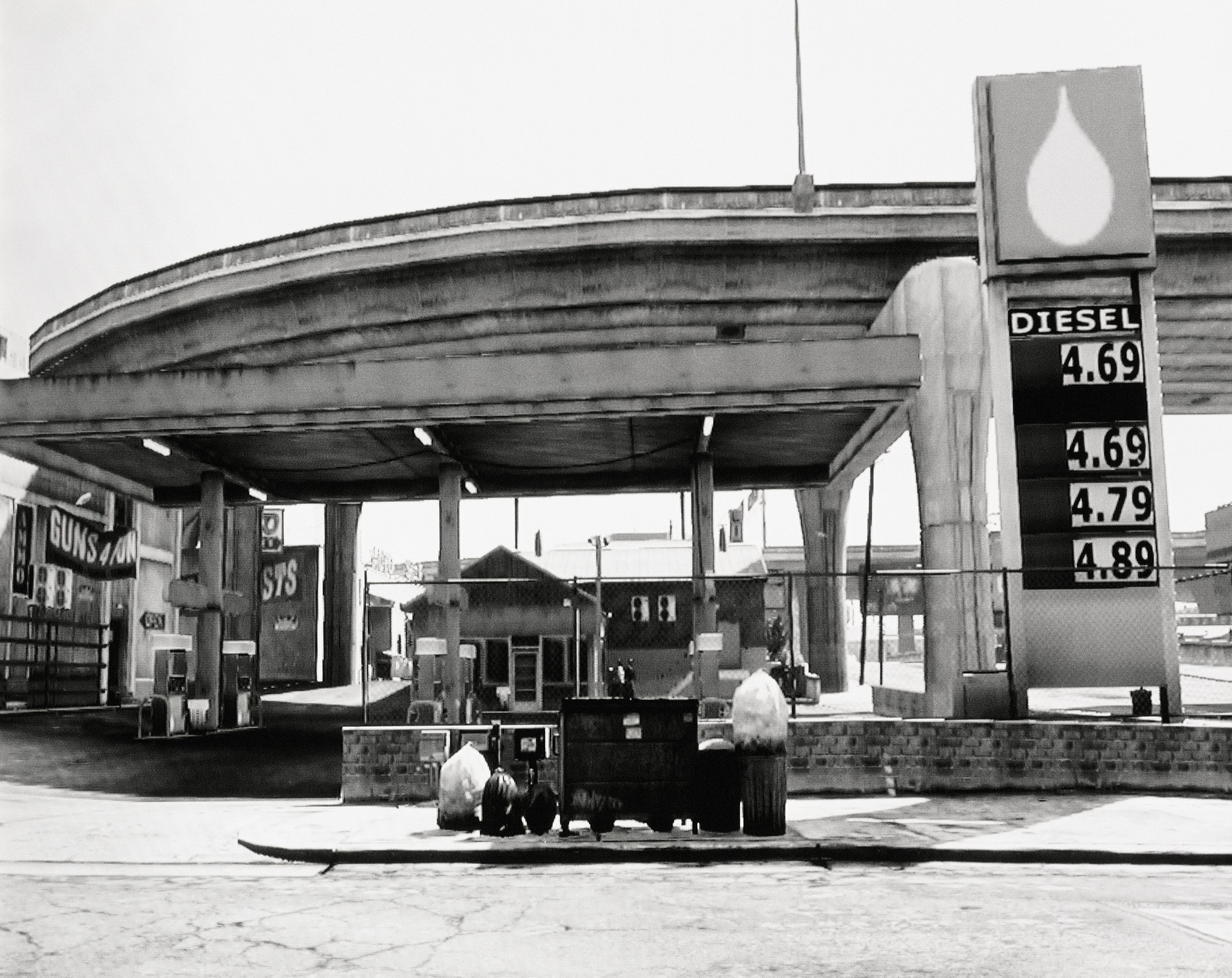
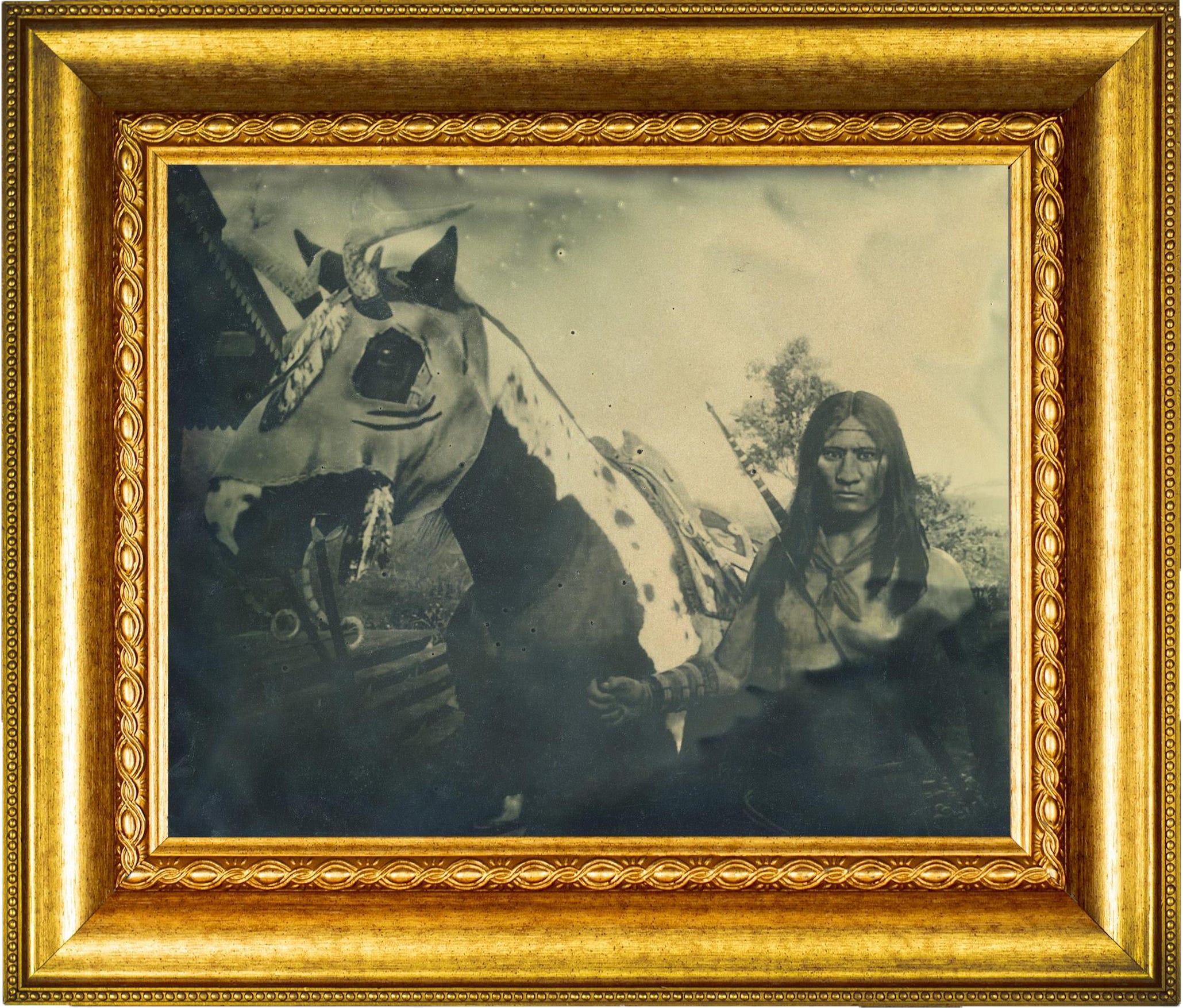
Works by Matthew Earl Williams (Confederated Tribes of the Grand Ronde) likewise deliciously darkened the concept of play in poignant and unexpected ways. Riffing on Ed Ruscha’s Twenty-six Gasoline Stations (1963), in 26 Gasoline Stations in Grand Theft Auto V (2014–2024) Williams used a large-format view camera to photograph gas stations depicted in the video game. While Ruscha reframed the mundane through the artist’s book, opening the door for experimentation in the media during the twentieth century, Williams highlights the changing media landscape for this generation through pastiche, shifting the digital back to the photographic. Williams’ nearby tintypes, obscured and overshadowed by Derrick Adams’ less interesting video projection Funtime Unicorn (2022), pull from the role-playing avatars of Red Dead Redemption 2, a video game set in the nineteenth-century “American West.” In Indians of the Uncanny Valley (2021), Williams uses tintypes, a nineteenth-century photographic process that creates a positive image on a thin sheet of metal, to playfully upend the viewer’s expectations. At first glance, the tintypes appear to be faithful period artifacts from the likes of those like Edward Curtis. They instead probe gaming culture and its strange representation of the contemporary West by photographing game players’ avatars of Indigenous people at a time when their rights were being stripped away by colonizers.

More nationally recognized artists were likewise represented in the exhibition. Vibrant prints from Derrick Adams’ Floaters series (2019) depict summertime fun and Black joy in full sumptuous color thanks to the expertise of Tandem Press. Less exciting was Takashi Murakami’s Superflat (2004) series and oil portraits from Jeremy Okai Davis, both of which were less directly relevant to the theme of the exhibition, but nonetheless showcased each artist’s practice.
On the whole, Just Playin’ Around is thoughtfully and precisely executed. All of the works on display across the two floors of the museum received rigorous, well-researched wall text in addition to a QR code inviting the viewer to listen to an extensive online audio guide. These wall texts, bilingual in both English and Spanish, correspond to a printed brochure that includes games for children and an interactive in-gallery scavenger hunt. This is plain ol’ high-quality museum work, and the attentiveness to details makes for an equalizing experience. In our current politically chaotic moment, when play and fun can feel increasingly difficult to capture, it is especially rare to find an approachable museum experience. Walking through the door of the JSMA (whose admission is free, I might add), I felt I could take anyone, of any age, of any background or lived experience, to that space, and they could find a point of entry into the works.
Just Playin’ Around
Jordan Schnitzer Museum of Art at PSU, Portland, OR
January 21, 2025 to April 26, 2025
This review was made possible by generous support from Critical Conversations, The University of Oregon Center for Art Research (CFAR), and The Ford Family Foundation.